Hi all,
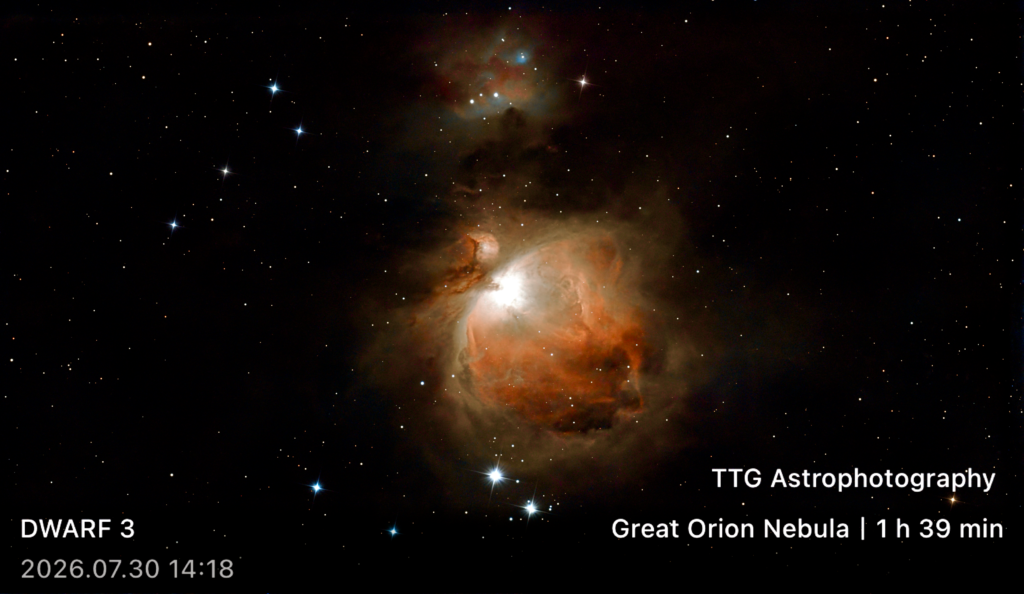
The initial plan was to capture Barnard 33, aka the Horsehead Nebula. However, it only rises about 30 degree altitude here after 22.00, and by then it was still behind our house (from my favourite spot for the Dwarf in the garden). I’ll need to rethink that positioning to try again.
Hence I only have my sub targets from last night, targets I add while waiting for my main subject to hit the appropriate conditions.
I started with visiting M27 Dumbbell Nebula again, which I capture for 1 hour of total integration time a while ago already.
Back then, the result of 1 hour lights was:
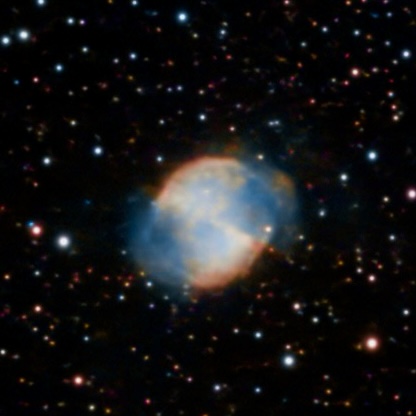
Yesterday’s result, with a total of 2h of lights, at 60 seconds exposure and gain 60:


Nice improvement by doubling the integration time. I tried combining the 2 sessions in one MegaStack, but it didn’t add much value to it. The automated MegaStack logic of the Dwarflab software only added a few minutes (4 or so) to the entire stack, discarding all the rest. Need to look into that, but it could be linked to the fact that the previous session was actually taken with my previous Dwarf 3 which got replaced under warranty.
In any case, this 2 hours capture of M27 holds quite a nice result in my opinion.
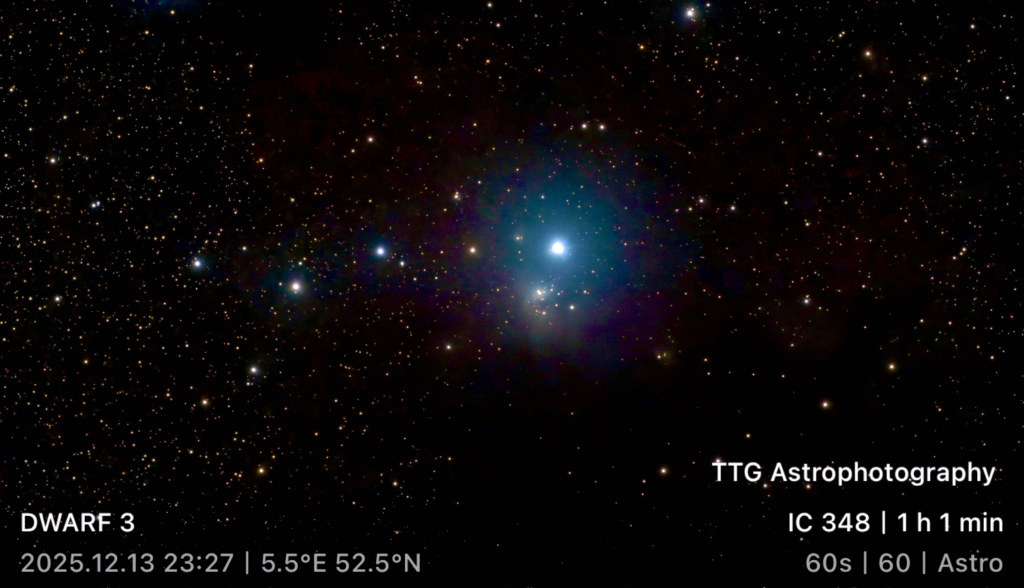
Next, I was scrolling through the Atlas and got triggered by IC348. Like I said before, my preference goes to capturing nebulae over galaxies in general, and especially those which generate a nice colourful picture. Blue in Astro filter for reflection nebulae, or red for emission nebulae in Duo-band filter. M45 Pleiades is obviously the best example of a blue reflection nebula, but IC348 looked quite interesting too.
IC 348 is a young stellar nursery tucked into the Perseus Molecular Cloud, about a thousand light-years away, where stars are still very much in the act of becoming themselves. What looks like a modest misty patch in a small telescope is in reality a compact open cluster embedded in faint reflection nebulosity, illuminated by hot, newly formed stars only a few million years old. The brightest of these is HD 281159, a massive blue-white star whose light sculpts and reveals the surrounding dust, while several other young suns crowd tightly around it, many still surrounded by protoplanetary disks. Just off to the west lies ο (Omicron) Persei, an unrelated but striking foreground star that often sneaks into wide-field images and helps frame the scene. IC 348 is a reminder that even in a quiet-looking corner of Perseus, stellar birth is ongoing—messy, energetic, and luminous in ways that only long exposures truly reveal.

Another successful stargazing session booked!
Barnard 33 remains on the to do list for one of the next clear skies!
To endless exploration, starry nights, and a little bit of cosmic nerdiness!
TTG