Hi all,
As mentioned in my previous post, I took the opportunity of the clear sky to capture 2 targets tonight.
First of all, because I wanted to put the Dwarf to work while I wrote the previous post, but also because the 7 sisters were already on my to do list for a while. Previously they were typically too low in the sky to capture them. Now they are proudly raising high enough to capture them at a somewhat reasonable time during the night.
The Pleiades (M45), also known as the Seven Sisters, is one of the most famous and easily recognizable open star clusters in the night sky. Located about 440 light-years away in Taurus, it contains hundreds of stars, though only six to seven are visible to the naked eye. The cluster is enveloped in faint blue reflection nebulae, caused by interstellar dust scattering the light of its hot, young stars—most notably around Maia (the Maia Nebula) and Merope. At roughly 100 million years old, the Pleiades is still young on cosmic timescales, and its dazzling beauty has inspired myths and legends across cultures for thousands of years.
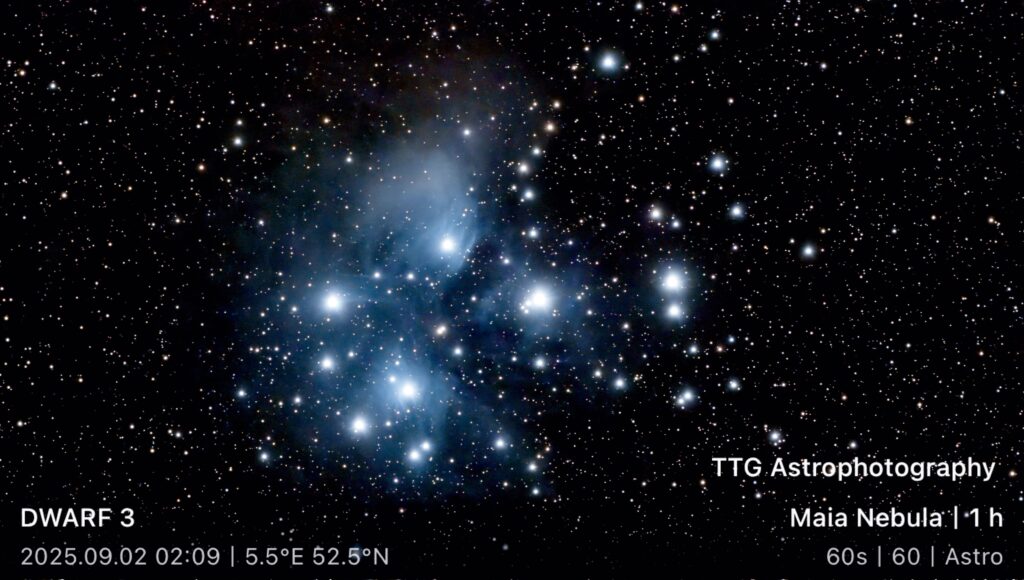
1 hour – 60 subs – 60 seconds – Gain 60 – Astro filter
I limited the session time to 1 hour, not to exaggerate the sacrifice of my night sleep too much. I’ll for sure visit them again in the future to add more integration time, but look at the blue nebulosity with only 1 hour of light on the target! They do shine beautifully those 7 sisters!
The Dwarf 3 tagged M45 as the ‘Maia Nebula’. As mentioned above, referring to one of the brighter stars in the cluster.
I’ve been told that my Zodiac Sign is Taurus. Not that I believe much of that nonsense, as I prefer to limit my believes to science and astronomy, but just for the fun of it a bit more information on where to find the 7 sisters.
M45, the Pleiades, is located in the constellation Taurus, appearing on the Bull’s shoulder.
Nearby, the bright star Aldebaran marks Taurus’s eye, while the Hyades cluster forms its V-shaped face.
Though they appear connected in the sky, the Pleiades is a separate star cluster much farther away.
M45 can be spotted with the naked eye. Look for a tiny “dipper”: The Pleiades appear as a small, misty clump of 6–7 stars, often mistaken for a miniature Little Dipper. They’re easiest to see in the winter months (Nov–Feb in the Northern Hemisphere), high in the evening sky. In the Southern Hemisphere, look for them in the summer months.
I started tonights session trying to capture the Wizard, and added M45 as an extra target for tonight. However, I’m really impressed by the result of this capture. Amazing target! Worth visiting again later this winter.
To endless exploration, starry nights, and a little bit of cosmic nerdiness!
TTG