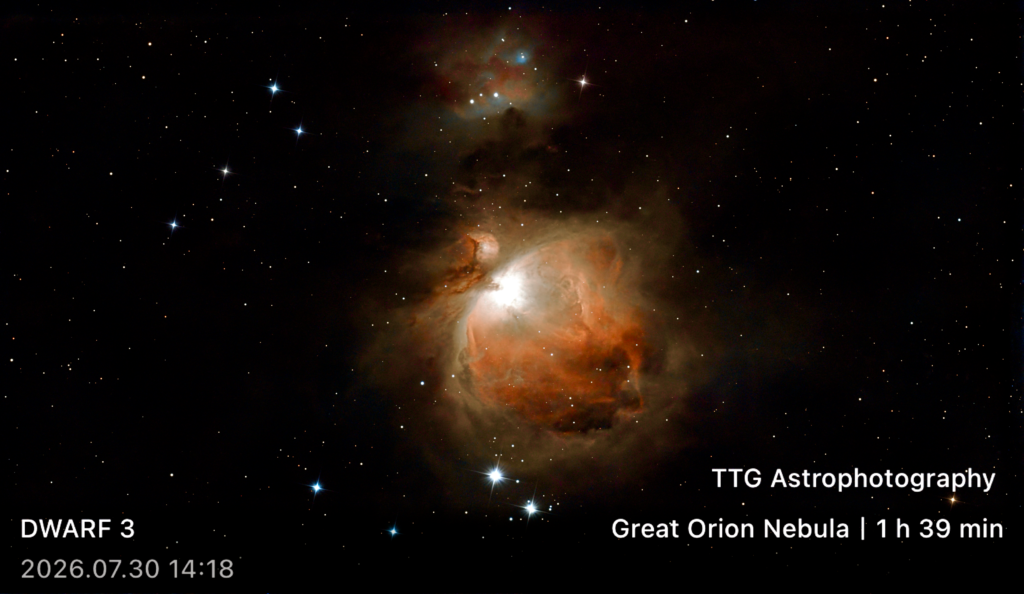
Hi all,
Things got a bit busy and the weather was yet again not on my side the last few weeks. But things improved and I finally found an opportunity to test the new Dwarflab feature to capture the Milky Way.
It’s honestly a great functionality which has been added to the Dwarf scopes, but needs to be said, not an easy one. And this has nothing to do with the Dwarflab software or the scopes, but all with the fact that you do need quite some large clear field of view to get a nice framing of the Milky Way. Houses, trees or other objects can be a bit of pain for those who are using their smart telescope in city environments, or from their backyard.
I do have quite some clear viewing directions in my backyard, but still struggled a bit to get the framing right, avoid strange artifacts on the sides or light bleed from different sources.
However, I did manage to capture this – cropped – picture of the Milky Way a few days ago – around 90 minutes of total integration time at 60 seconds and gain 10:

Reason I had to crop it was because of artifacts and light distortion on the edges, caused by lower trees and the neighboring houses. Regardless, while I know the Dwarf 3 can do much much better, still happy with this initial result. Will give the Dwarf some opportunities in the next few days or weeks to capture more of the Milky Way and see where that brings me!
Bonus pictures, added some star spikes and also exported a starless image. I do prefer more original pictures, with a balanced post-precessing, so not sure if I will use the different star spike options which are now added to the app a lot, but it does add some additional creativity to the pictures. Can be nice in some situations and it’s nice that this is done within the software, without the need of additional hardware additions.


As the weather stayed clean and no rain was forecasted at all during this current heatwave in the Netherlands, I took the opportunity to do another unattended and scheduled session. In December I captured M31, with the following result with 3h and 47 minutes of lights. Didn’t do much post processing on that capture back then.

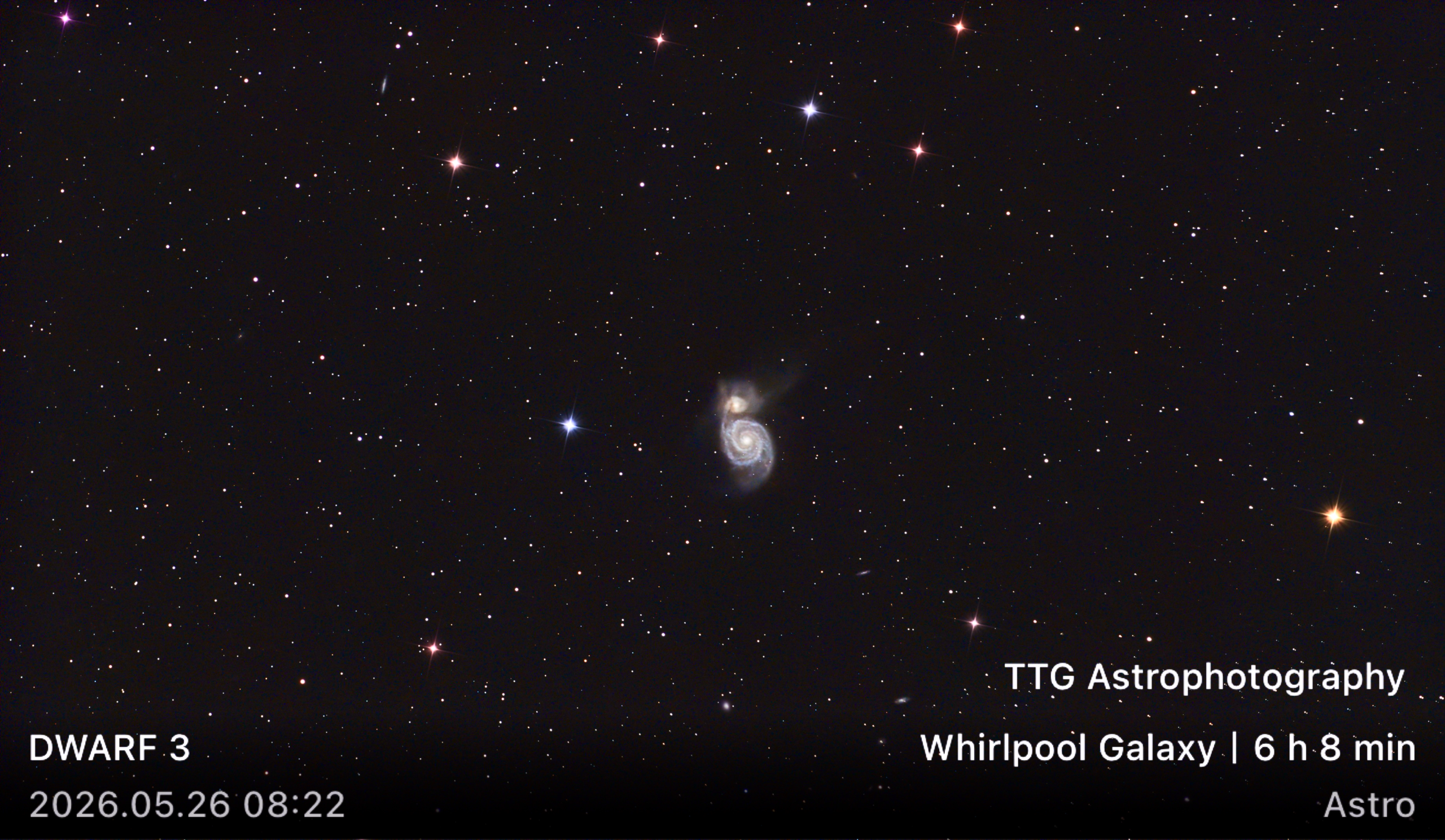
M51, the Whirlpool Galaxy (NGC 5194), is one of the sky’s great demonstrations of cosmic choreography. Lying about 23 million light-years away in Canes Venatici, it is a classic grand-design spiral whose elegant arms are being actively shaped by its smaller companion, NGC 5195. The gravitational interaction between the two compresses gas along M51’s spiral arms, triggering bursts of star formation that glow blue with young stars and pink with hydrogen emission, while dark dust lanes trace the underlying structure. Seen nearly face-on from Earth, M51 offers a remarkably clear view of how gravity sculpts galaxies over millions of years, turning a slow tidal encounter into a luminous, swirling masterpiece. Because the two galaxies are so closely linked in the sky, astrophotographers almost always capture NGC 5194 and NGC 5195 together, revealing not just the Whirlpool itself, but the interacting galactic pair that creates its iconic appearance.
Adding yesterdays session to the mix with Megastack gave me this – straight from Stellar Studio.

And after some tweaking on the curves and colors, while trying not to overdo it:
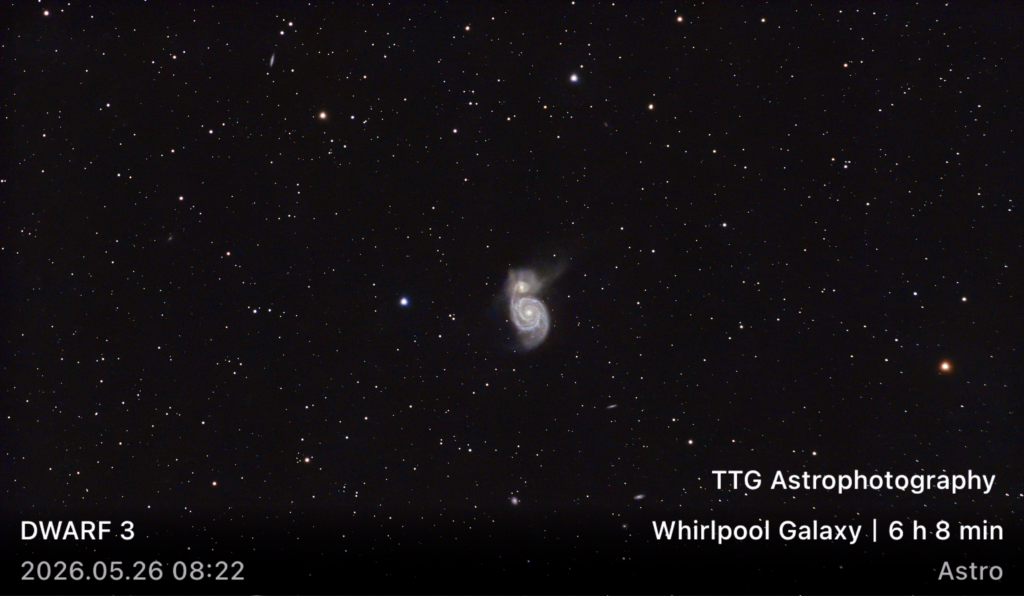
Compared to the capture from December, quite happy with the result.
Next, a version with the star spike functionality, and a bit more aggressive post editing to pop the colors… giving it a bit more artistic look. All subject to everyones personal preferences:

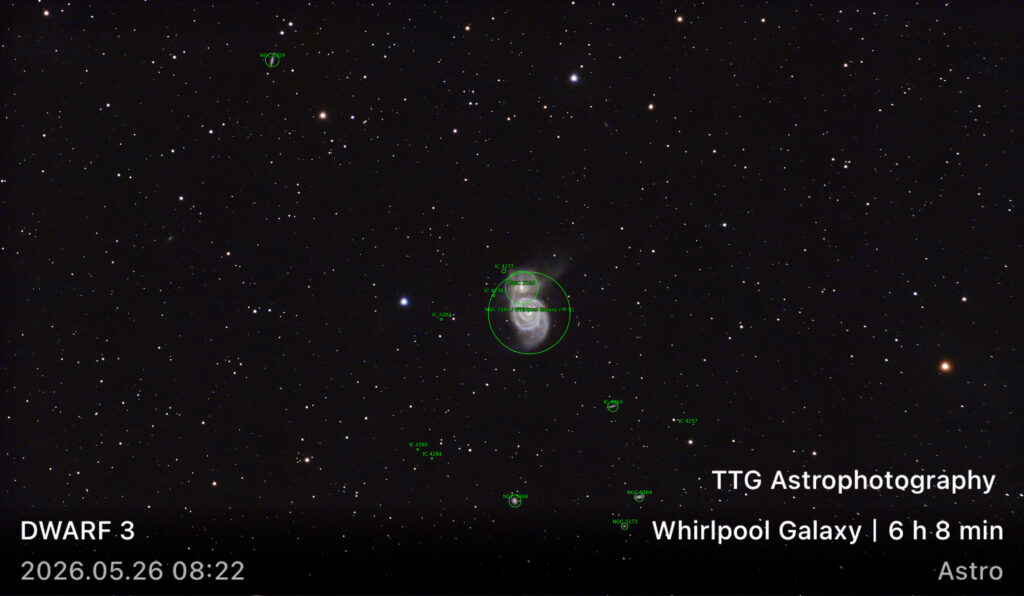
Finally, after seeing there were quite some much smaller objects capture in this session, I also ran it through Astrometry to identify them! NGC5229 – IC4263 – NGC5198 – NGC5169 – NGC5173 as main objects. All a tiny bit too small to select as main target, but nice bonuses!
To endless exploration, starry nights, and a little bit of cosmic nerdiness!
TTG