Hi all,
With the current weather and clouds in the Netherlands, every opportunity to put the telescope out needs to embraced. So 2 days ago I attempted to capture the Horsehead Nebula (IC434) after positioning the Dwarf so that the house would’t obstruct the view like during my previous attempt.
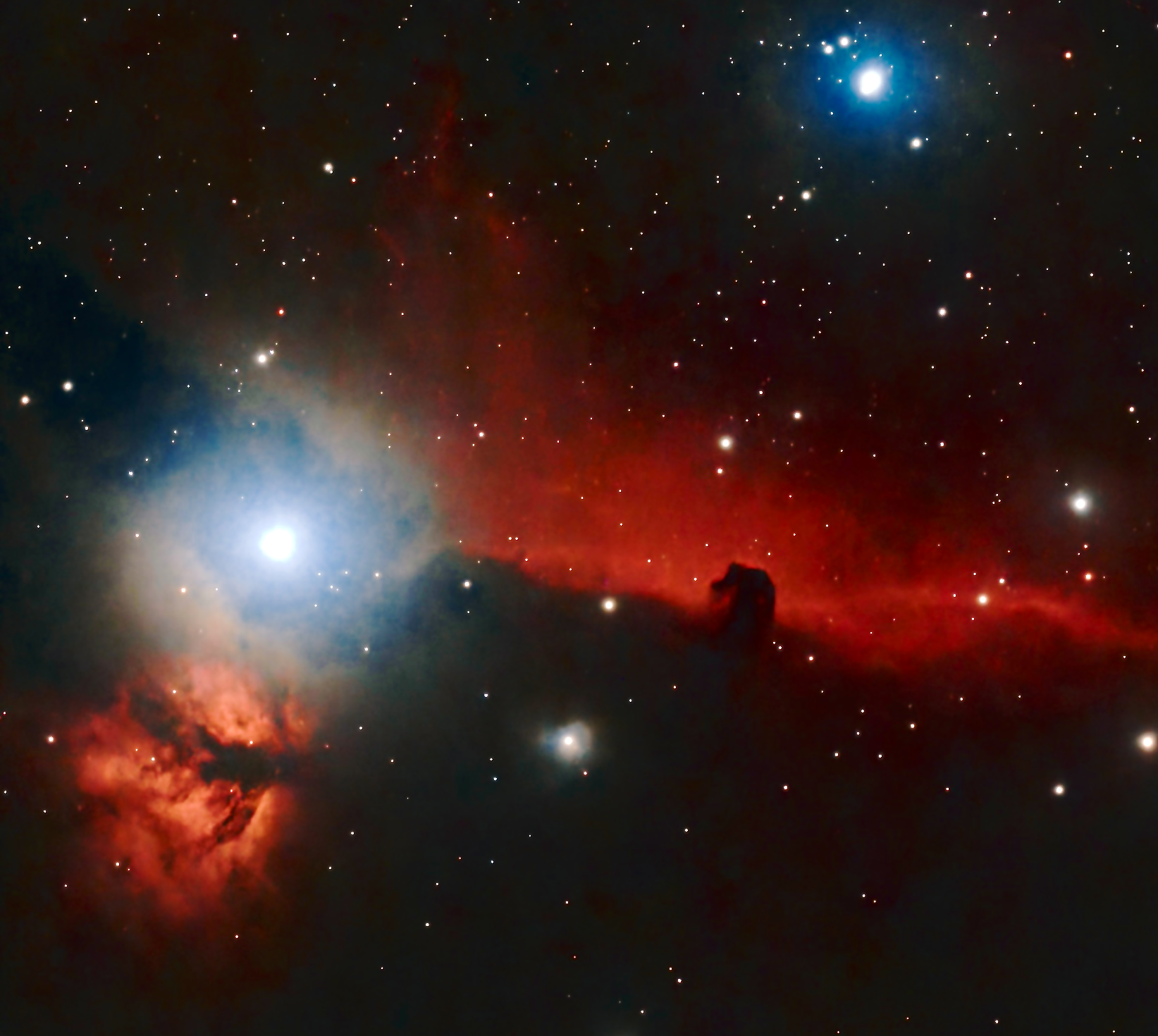
IC 434 and NGC 2024 sit side by side in Orion’s eastern belt region, a dramatic study in contrast shaped by the same stellar forces. IC 434 is not the Horsehead itself but the faint, glowing curtain of hydrogen gas lit from behind by the blue supergiant Sigma Orionis; against this luminous backdrop, the Horsehead Nebula (Barnard 33) appears as an inky silhouette, a dense knot of cold dust where star formation is quietly brewing. Just to the north lies NGC 2024, the Flame Nebula, whose fractured, flame-like appearance comes from dark dust lanes slicing through a bright emission nebula powered by massive young stars hidden within. Together they form a textbook example of how light, dust, and gravity interact in stellar nurseries—one nebula revealed by what it blocks, the other by what it emits—making this region one of Orion’s most evocative and instructive deep-sky sights.
The weather wasn’t optimal, as there were some cloud layers rolling in, but from an optimistic point of view, I thought I would be able to capture at least a good amount of pictures in the stack to get something out of it.
However, as the session evolved, long stretches of clouds started to overlay the area where IC434 was located. I did’t want to stop the session and assumed that the Dwarf would discard most of the pictures where clouds where obstructing the object, but it seems that a good set of images actually made it to the stack.
This created a final image where the long cloud layers where actually very visible and the Duo-Band filter created a gradient in grey/red bands. Overall not too bad for 1 hour of integration time, but yeah, with the horizontal cloud layers visible, quite below the image quality I’d typically consider as a good result.
Original image, auto processed with Stellar Studio.
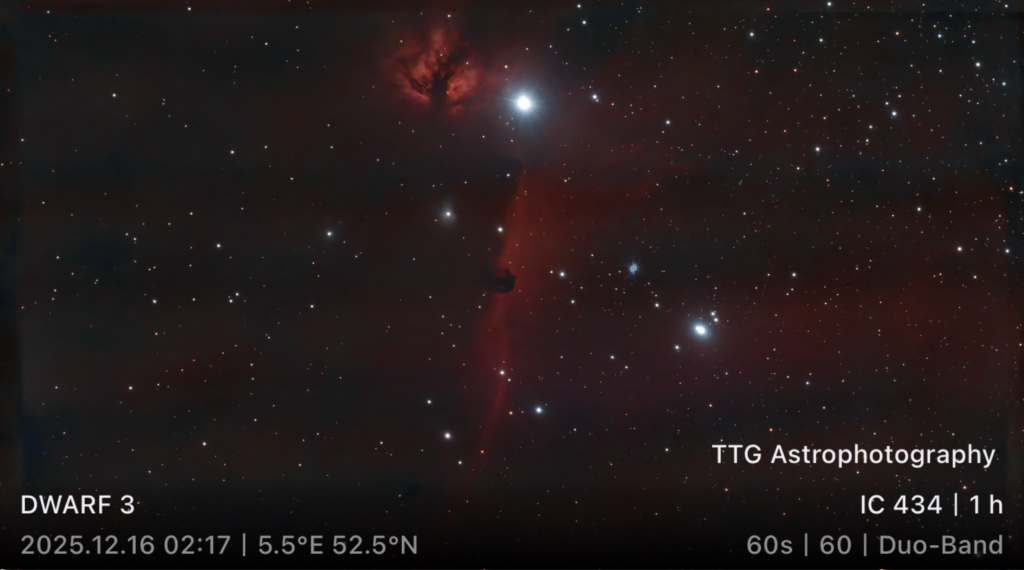
Nothing to blame the Dwarf for, sometimes the weather is what it is, and so is the end result. However, in an attempt to see what I could get out of it I tried popping the light and color a bit in Apple Photo’s app. As you may know from previous blogposts, my goal with this telescope is to keep the effort and post-processing work as light as possible. This to honor the simplicity of use this telescope gives us.
But in order to get rid of the horizontal cloud layers, visible in the picture, I had to go a bit aggressive on the RGB curves etc. While I’m typically a bit more fan of higher saturation and luminosity, compared to many other astrophotographers, de gustibus non est disputandum, tweaking this image in this way resulted in data loss as some areas, where the clouds where messing things up, actually also contained nebulosity image data.
The end result was hence nothing more than an attempt to keep something from the session, unknown when the next opportunity would be to put the telescope out. Taking the aggressive edit out of the equation, knowing the Dwarf 3 is capable of much more quality, at the end it is still amazing to see what we can observe in deep space with this amazing device:


However, although not anticipated at all, last night brought another opportunity. Despite the sky being a big hazy (light clouds layers again here and there), and the fact that I need to position the Dwarf in the direction of some light sources on our street (in view of the relatively low altitude of IC434), I gave it another try to capture this amazing object.
Seems the clouds didn’t cause much trouble this time, and this gave me the following 2 hours and 26 minutes of good data. This on a total session of 3 hours, at 60 seconds exposure and gain 60:
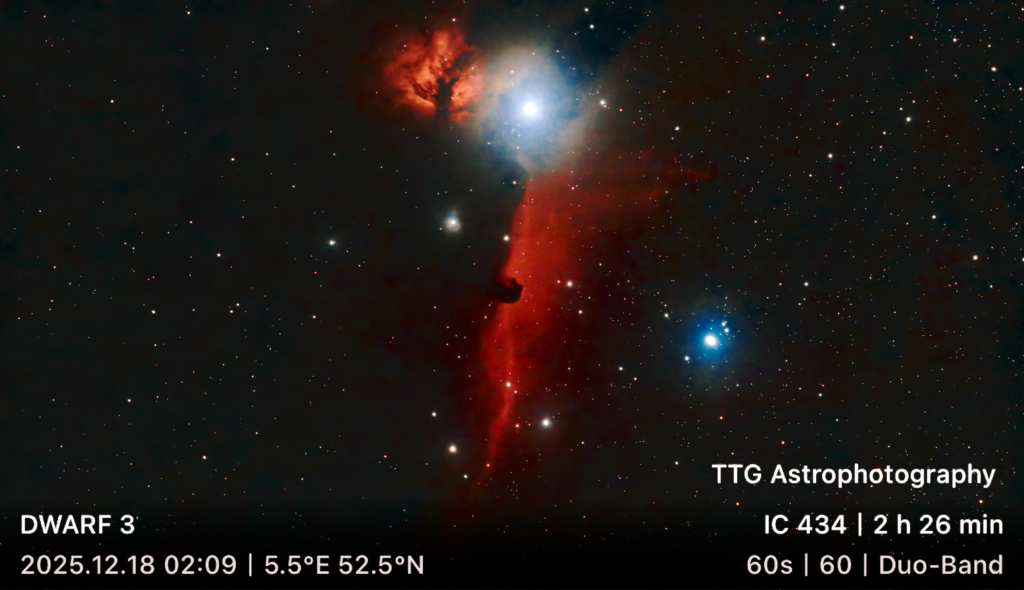

I tried to combine the 2 sessions in one Megastack, but the first session, filled with a majority of subs overlayed with clouds, added more bad frames than good ones, so no point adding that hour of integration time to it. However, IC434 is for sure one of those targets which benefits from adding much more data to it, so this Horsehead Nebula remains on the list for future sessions.
For now, quite happy with this result! Horsehead Nebula (and NGC2024 Flame Nebula) logged!
To endless exploration, starry nights, and a little bit of cosmic nerdiness!
TTG