Hi all,
After 6 days of clouds and rain, finally another clear night sky!
Today I attempted one of the Dwarf 3’s amazing features which I didn’t test out yet: Mosaic capture.
The Mosaic mode of the DWARF 3 turns its small field of view into a wide-angle canvas. Instead of capturing a single frame, the telescope automatically shoots multiple panels in a grid pattern and stitches them together. This lets you cover larger objects which don’t fit in one shot. The result is a seamless wide-field image while keeping the fine detail of the telescope’s resolution.
I captured the Western part of the veil Nebula (C34 or NGC6960) in one of my previous sessions, but haven’t got to the Eastern part yet (C33 or NGC6992/6995). Hence for this Mosaic test I selected a field of view covering both, at 30 seconds exposure, gain 60 and of course the Duo-band filter.
The result is amazing!
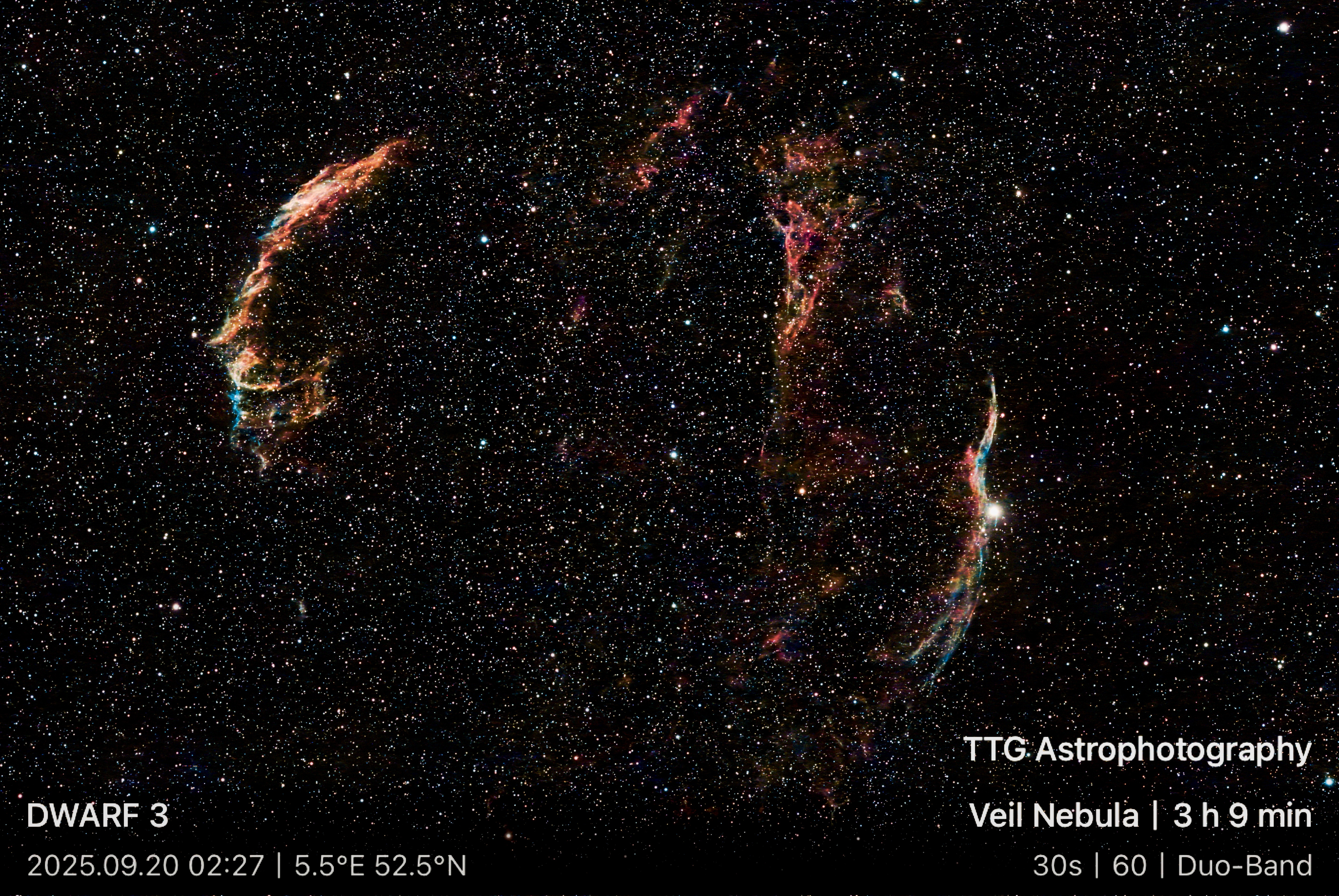
The Veil Nebula in the constellation Cygnus is one of the most spectacular examples of a supernova remnant. Around 10,000–20,000 years ago, a massive star ended its life in a titanic explosion, scattering its outer layers into space. Today, we see the aftermath as a giant bubble of glowing gas and tangled filaments that stretch across almost three degrees of sky — about six times the diameter of the full Moon.
Astronomers divide the nebula into several regions. The Western Veil, catalogued as NGC 6960 and often nicknamed the “Witch’s Broom”, lies near the bright star 52 Cygni. On the opposite side is the Eastern Veil, listed as NGC 6992 and NGC 6995, which forms bright, intricate arcs of hydrogen and oxygen. Between these two main structures lie fainter wisps, including NGC 6974 and NGC 6979, giving the whole complex its lace-like, ghostly appearance.
Definitely going to use the Mosaic mode on some other targets in the future!
To endless exploration, starry nights, and a little bit of cosmic nerdiness!
TTG