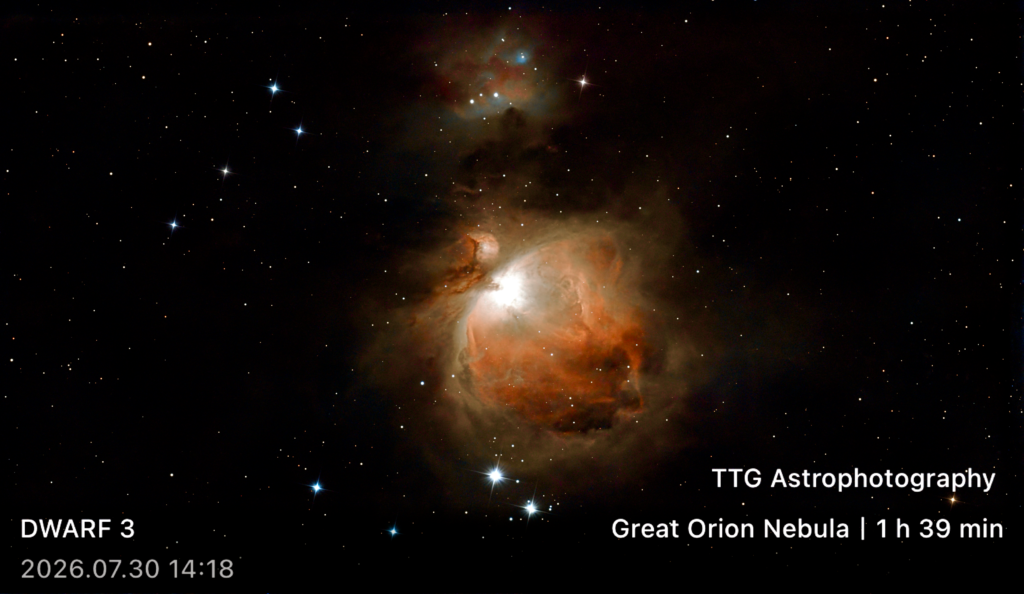
The cold winter period brings frosty dry nights. Nice to confidently leave the Dwarf 3 outside at night without the risk of rain.
This allowed me to schedule a few longer sessions to capture some smaller targets and benefit from the longer integration time.
Last night I gave M51 some attention, with almost 4 hours of light on target. Quite small compared to for instance the massive Andromeda Galaxy, but it shows how powerful the Dwarf 3 actually is if you give your targets enough integration time and light on target! Beautiful!
M51, the Whirlpool Galaxy, is one of the sky’s great demonstrations of cosmic choreography. Lying about 23 million light-years away in Canes Venatici, it is a classic grand-design spiral whose elegant arms are being actively shaped by its smaller companion, NGC 5195. The gravitational interaction between the two compresses gas along the spiral arms, triggering bursts of star formation that glow blue with young stars and pink with hydrogen emission, while dark dust lanes trace the underlying structure. Seen nearly face-on from Earth, M51 offers a clear view of how gravity sculpts galaxies over millions of years, turning a slow tidal encounter into a luminous, swirling masterpiece.


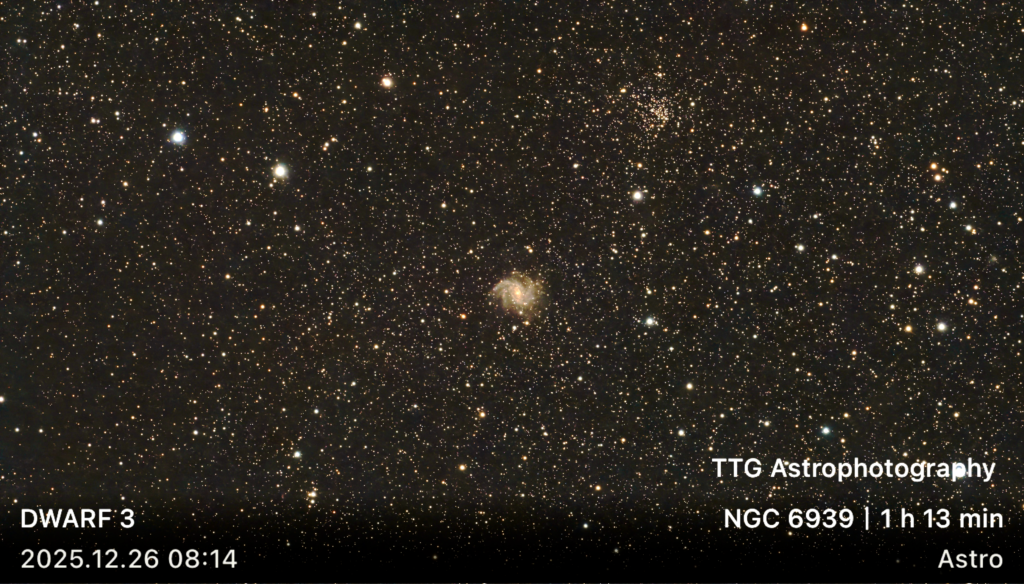
Another target I pointed the Dwarf to, actually yesterday morning, was NGC6946, the Fireworks Galaxy. Tagged as NGC6939 by the Dwarf app, in view of the close vicinity of that cluster. It’s a smaller galaxy which may need a bit more integration time, but I only added it early morning after finishing the overnight schedule.
NGC 6939 and NGC 6946 make an intriguing pair because they sit close together on the sky in the constellation Cepheus, yet represent entirely different layers of the universe. NGC 6939 is a Milky Way open star cluster only a few thousand light-years away, a compact group of aging stars quietly evolving within our own galaxy. Just a short telescope hop away lies NGC 6946, the Fireworks Galaxy, a massive face-on spiral roughly 22 million light-years distant and renowned for its frequent supernova explosions driven by intense star formation. Seen together, they create a striking line-of-sight contrast: a nearby, orderly stellar family in the foreground and a turbulent, star-forming galaxy far beyond it. This pairing is a beautiful reminder that objects appearing neighbors in the night sky can, in reality, be separated by vast gulfs of cosmic depth.

And finally a MegaStack of NGC1333, combining last night’s session with one from a few weeks ago. A small nebula which may benefit as well from quite some more light on target. So it remains on the list of items to continue to give some attention in the future.
NGC 1333 is a vivid stellar nursery embedded in the Perseus molecular cloud, about 1,000 light-years from Earth, where stars are being born right now rather than quietly aging. This reflection nebula glows with scattered blue light from young, hot stars still wrapped in the remnants of their natal gas and dust, while deep within, protostars drive energetic jets and outflows that carve knots and shock fronts into the surrounding cloud. The region is rich in infrared sources and Herbig–Haro objects, revealing a chaotic environment where gravity, radiation, and turbulence are all competing to shape new suns. NGC 1333 offers a rare, close-up look at the messy, dynamic early chapters of stellar evolution, long before calm, settled star systems emerge.


To endless exploration, starry nights, and a little bit of cosmic nerdiness!
TTG