Hi all,
The weather is still a bit of disappointment, but at least I got some minor window of opportunity to attempt capturing some targets. The most important object out there, which I urgently wanted to capture, was (and still remains) Comet C/2025 R2 Swan.
Unfortunately, the viewing window is not that big in the Netherlands. By the time it gets dark R2 Swan is about to dip below 30 degrees of altitude, which (in combination with the cloudy weather) makes it very tricky to capture. On the night from the 1st of November to the 2nd, I had a very small window shorty after 7PM CET to attempt capturing R2 Swan, but that only lasted for 30 minutes before some clouds started to roll in again.
On top of that, the moon is currently in Waxing Gibbous phase, which makes the sky quite bright, and hence complicates capturing the fine details of a comet even more.
Nevertheless, I did manage to capture a faint glimpse of it during a few very short session in between the clouds, and this is somehow the best one. Very faint, not much detail, but still recorded:

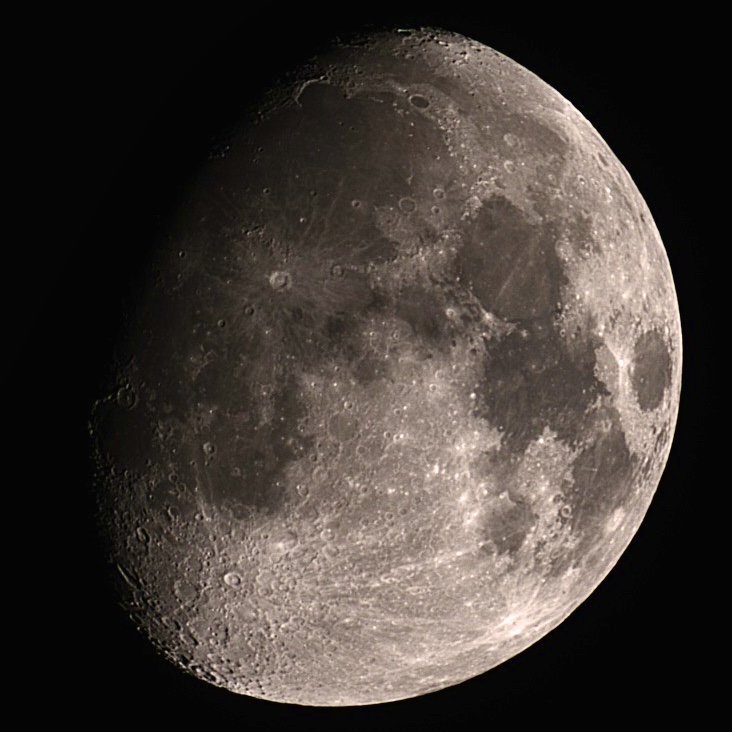
While I had the Dwarf 3 out anyway, I took the opportunity to capture our lovely Moon with a few stacked images at 1/250 seconds exposure and VIS filter. Although Deep Sky objects always have that extra touch of cosmic magic, it still remains an amazing object to look at!
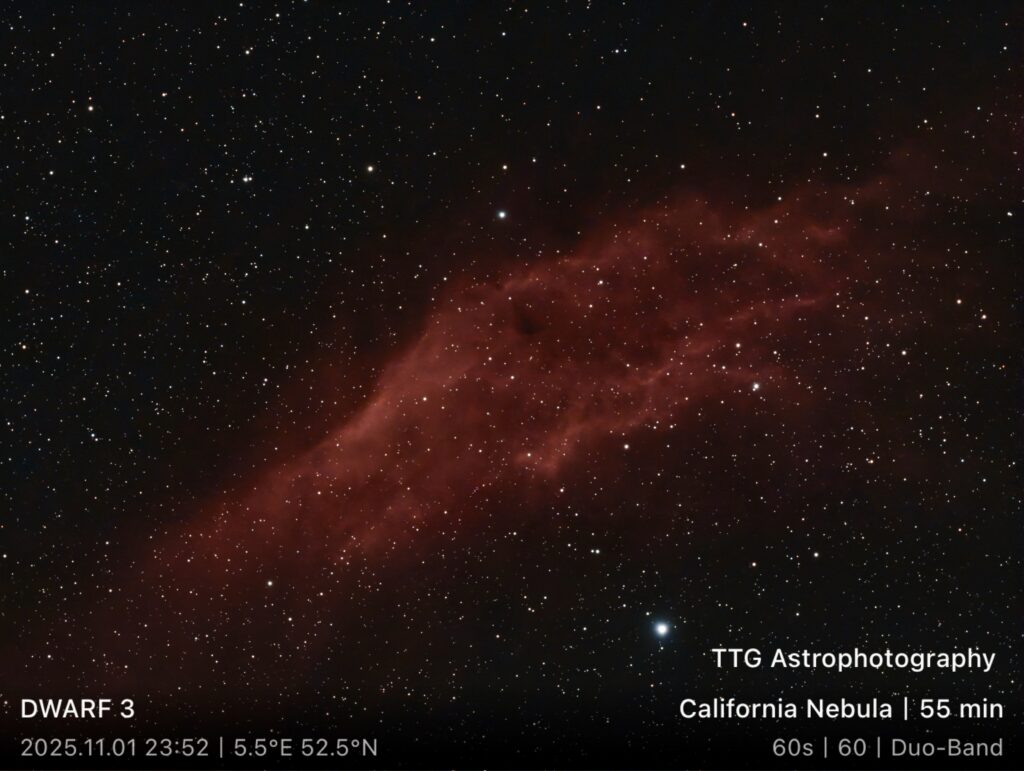
Later that night, the sky cleared up, for a short period. So I put the Dwarf 3 out again and programmed a Mosaic capture of NGC1499, aka the California Nebula. I went for a Mosaic of 1.0 x 1.4 the FOV of the Dwarf, to nicely capture the entire nebula. My plan was to go for 3 hours of total light, which in mosaic mode would mean 1,5 hour on each region (image composed of 2 regions shot alternatively and then automatically stacked together in the Dwarflab app). However, a bit short of 1 hour into the session, the entire sky started to become overcast again, so I had to abort the session.
Nevertheless, the power of the Dwarf 3 did not disappoint, as although I would have preferred to capture a bit more detail, the result remains stunning!
NGC 1499, better known as the California Nebula, stretches like a glowing red ribbon through the constellation Perseus, about 1,000 light-years away. Its long, curving shape uncannily resembles the outline of the U.S. state it’s named after. The nebula shines primarily in the deep crimson light of ionized hydrogen (H-alpha), energized by the nearby hot blue star Xi Persei (Menkib). It’s a vast emission cloud—spanning more than 2.5° of the sky, five times the apparent diameter of the full Moon—making it a perfect target for wide-field astrophotography and narrowband filters that bring out its rich textures of cosmic gas and dust.
California Nebula – 55 min of total Mosaic mode – 60 seconds exposures at gain 60:
To endless exploration, starry nights, and a little bit of cosmic nerdiness!
TTG