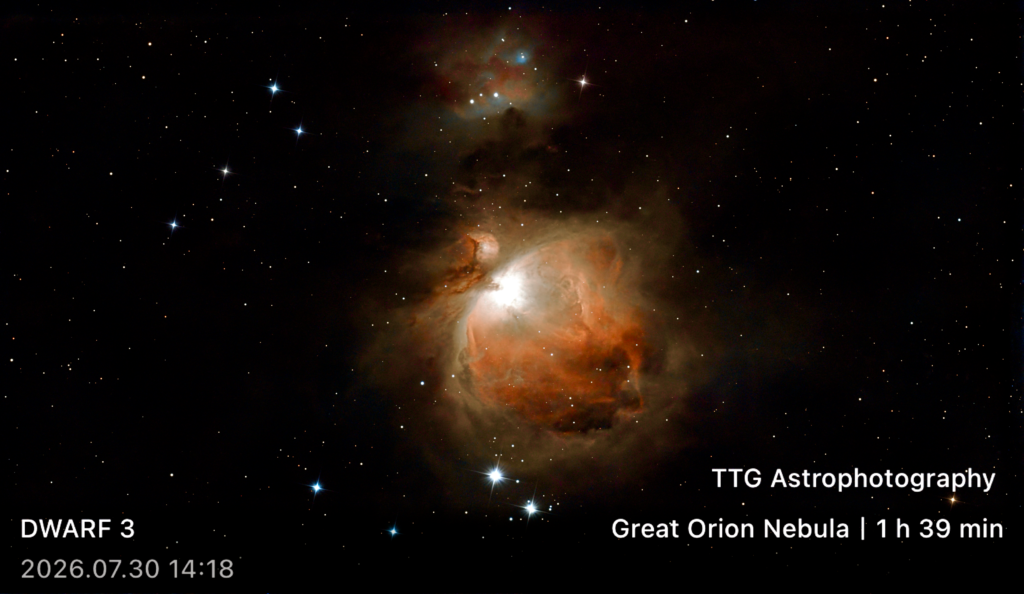
Hi all,
It’s now a few weeks since I got the Dwarf 3 and I must say the experience has been awesome, confirming my initial impression I posted 1 day after receiving the telescope.
From the quick captures of the sunspots, some stacking of the Moon, to the beautiful Andromeda galaxy and several deep sky objects like M16, M17, NGC281, etc. Exploring the night sky as effortless as it gets with the D3 has been an amazing journey so far.
I took the Dwarf with me on holiday to Maspalomas, Gran Canaria, where even the confines of a hotel balcony (with ceiling) and the Bortle 7 light pollution didn’t cause too much trouble for the mighty D3.
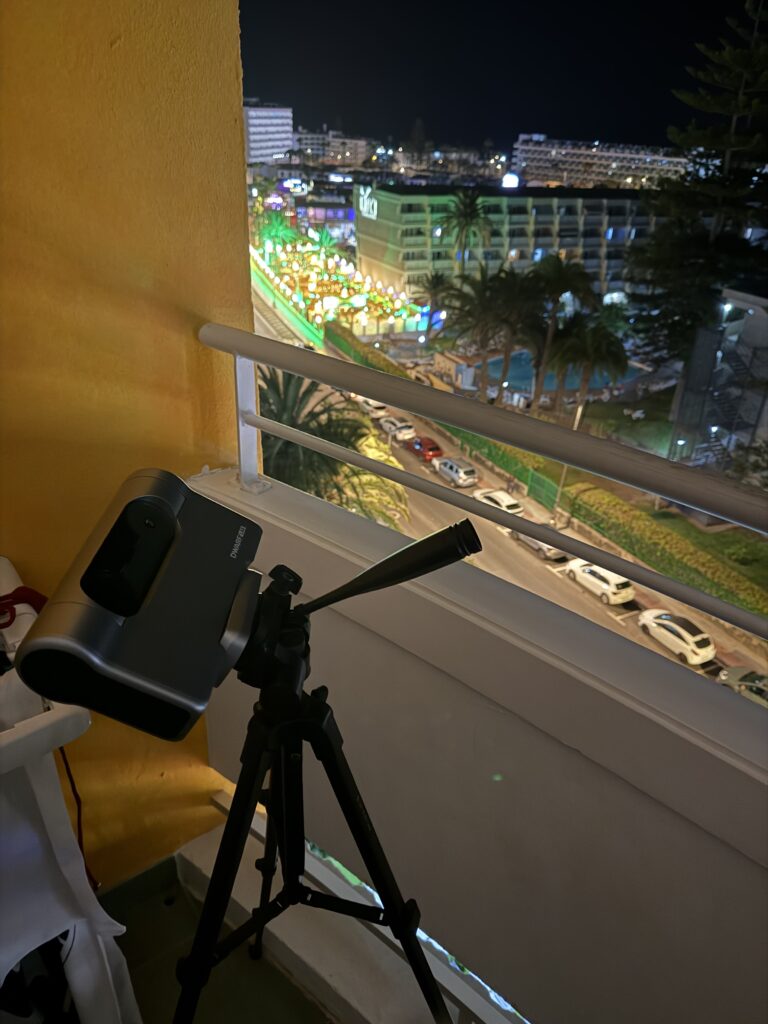
Even with a limited field of view (South-East to South-West direction), the Dwarf was able to calibrate the EQ mode and complete the polar alignment. Sometimes it struggled a little bit and required multiple attempts or minor repositioning of the tripod, but it managed to get it done every time. Limiting my capturing sessions to short integration times, in order to avoid sacrificing my holiday sleep too much, I was able to get some nice images of the ‘Eagle’ and the ‘Horseshoe’ nebula, as well as a nicely stacked image of the Full Sturgeon Moon.
The objects I could target were a bit limited in view of the waxing Moon, which was right in the middle of my, already limited, field of view, but overal happy with the captures I was able to do and the fact that I could just take the Dwarf 3 with me in my hand luggage.
The folks at Dwarflab have also been very supportive so far, and truly showing their love and appreciation for their customers. I broke the little poach of the solar filter, as I managed to pull the little cord out of it. Not a big deal, however, I contacted Dwarflab and they were so friendly to just send me a new one.
I shared the blogpost with my initial impression of the Dwarf 3 with them, and got it featuring on the official Dwarflab website. In return for sharing my story, they sent me a hat and shirt, which I really appreciate! I love swag! Further more, 2 weeks later, I received another email stating that my post was selected as winner of the user story telling contest, for which another ‘surprise merch’ gift package is on it’s way!
Not only did the folks at Dwarflab make an impressive product, which is still under continuous development/enhancements with firmware updates, they truly understand how to engage with customers, built a community (Facebook groups, Reddit, etc…) and show appreciation for their users. Genuinely a nice experience!
So where does this leave me now? What’s next? Well, first of all I still have the capture of the Full Sturgeon Moon I need to upload here, and the Veil Nebula I captured 2 days ago when I got back home. Coming up.

Apart from that I decided that my short term strategy to learn will be to limit my sessions to 30 / 60 minute integration time. I don’t trust the weather in the Netherlands that much to leave my D3 unattended outside over night during scheduled sessions. Yet, as I will get over this I guess, but I’m also too eager to capture a diverse collection of different objects, and learn more about the all the different night sky objects out there. I have a lot of catching up to do as I delayed this hobby for way too long.
Thank you Dwarflab to pull me into this wonderful world so I can finally do what I’ve postponed for way too long (see my reasons in my initial impression post). It may be nerdiness overload, but still, the moment you see the image grow, stacked sub after stacked stub, is just mesmerising. I know, one can just Google the image of any night sky object, and see images taken by immense telescopes, but that just defeats the nerdiness and joy of capturing it yourself. Another reason I didn’t go for any scheduled session, it’s all about the experience.
Also from a technical side of things I still have a lot to learn. The Dwarf 3 makes the settings intuitive and easy to use, but there is still some level of skill required in view of understanding the best shutter time and gain. I’ve experienced that going for 60 seconds exposure sometimes results in a bit higher failure rate (discarded subs which the D3 ignores in the stack), compared to for instance 30 seconds. Makes sense I guess, as there are a lot of variables which could result in getting sub discarded… some vibration on the tripod, clouds, light pollution, an object like a plane or a bird flying through your image, etc…
I need to read up a bit on the topic as I see conflicting opinions regarding exposure time. 2 stacked subs of 30 seconds ain’t same as 1 sub of 60 seconds, so I need to understand a bit more on what to choose and what to base this choice on. Same goes for the gain setting, which depending the object you try to capture, and the sky conditions, plays a bit role as well.
One thing I did indeed learn very quick was that total integration time is makes the biggest difference. Doubling or Quadrupling the integration time really changes the resulting stacked image massively, so patience is key here.
That said however, my short term strategy will be to do relatively short integration sessions of different objects. 30 to 60 minutes. Doing so I’ll get more familiar with the overal night sky and built a collection of things I’ve captured myself. Gotta catch ’em all right? Some people catch Pokemons (been there done that too), now I catch Galaxies and Nebulae 🙂
Along the way I’ll revisit previously captured objects to add more integration time. Subject to the conditions during the night, the time I have available, etc… I’ll slowly enhance the images I’ll be collecting. The possibilities are endless, and whenever I have a decent stack of images for a specific object, I may explore other tools for stacking outside the Dwardlab provided tools in the app and see what that gives me too. I have a lot to learn here!
But for now, MegaStack and Stellar Studio are just fine for me and they do an awesome job in my opinion!
To endless exploration, starry nights, and a little bit of cosmic nerdiness!
TTG