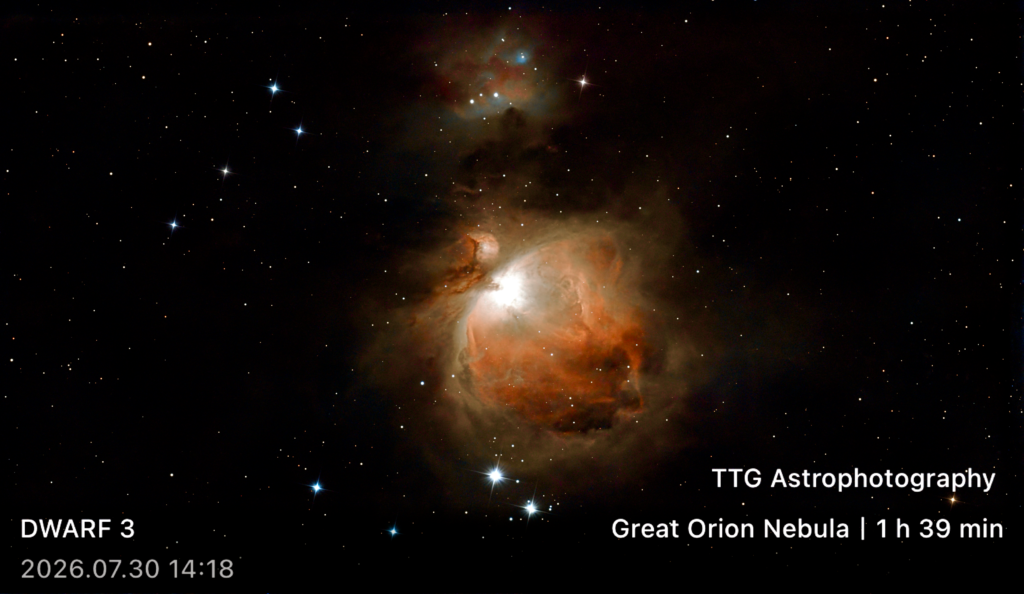
Last night I gave the Dwarf 3 another schedule to work it way through the night. Clear sky and no risk for any rain, so I could put the Dwarf to work, while I could enjoy a nice night sleep 🙂
The schedule I programmed was:
- IC 2574 for 2 hours (Coddingston’s Nebula)
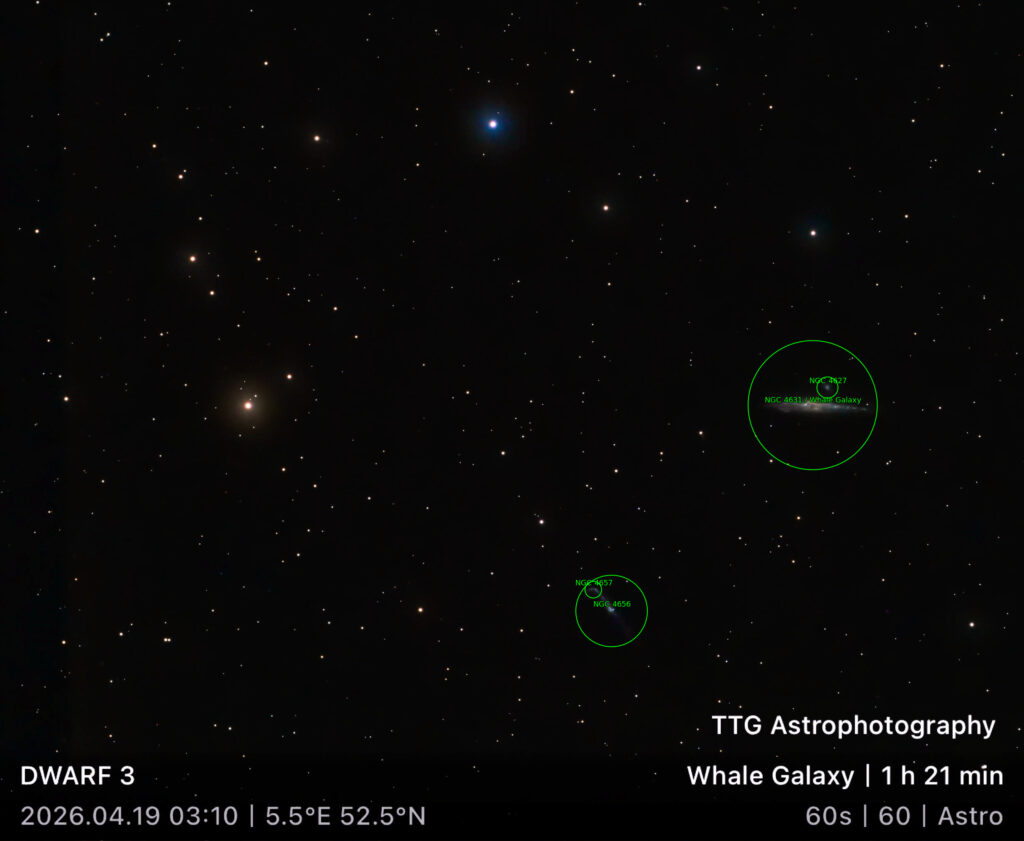
- NGC4631 for 2 hours (Whale Galaxy)
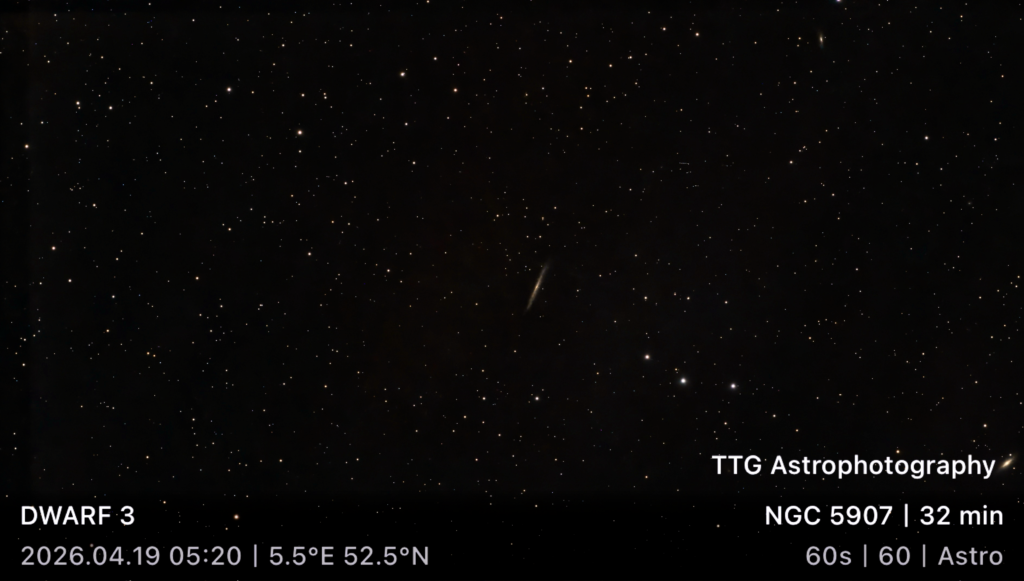
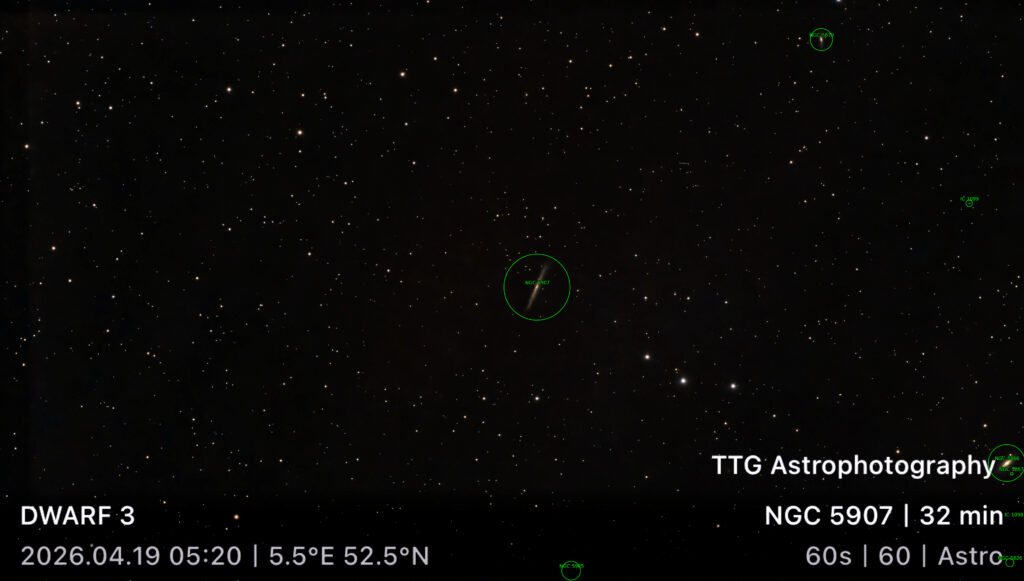
- NGC5907 for 2 hours (Knife Galaxy)
This resulted in respectively 1 hour 31 min, 1 hour 21 min and 32 min of stacked subs, with some additional bonus like NGC4656 Hockey Stick Galaxy. Not the fun 2 hours of light on each target, but as always there are many reasons why a certain amount of subs are discarded by the Dwarf (Meteors, Plans, Clouds, other objects and closer to the morning the upcoming Sun).
Overal a nice result for a totally automated capture! Especially as we are in ‘small galaxy and nebulae season’, making it harder to find large targets to capture. The more you get into Astrophotography, hunting for new targets to capture, the more you need to accept smaller targets which are more difficult to capture. Especially with limited time on target.
IC 2574, also known as **Coddington’s Nebula**, is a faint dwarf irregular galaxy located in the constellation Ursa Major. At roughly 12 million light-years away, it’s part of the same galaxy group as Messier 81 and Messier 82, but far less conspicuous. What makes IC 2574 fascinating is its patchy, chaotic structure—large regions of gas and dust where new stars are actively forming, giving it a mottled, almost “hole-punched” appearance in deeper images. Through the DWARF 3, it appears as a very subtle glow, but with enough integration time, those irregular star-forming regions begin to emerge, rewarding patience with a glimpse of galactic evolution in action.


NGC 4631, famously known as the **Whale Galaxy**, is a striking edge-on spiral in the constellation Canes Venatici, located about 25 million light-years away. Its elongated, slightly warped shape truly resembles a cosmic whale gliding through space, with dark dust lanes cutting across its luminous disk. What makes this target even more rewarding is its close companion, the interacting pair NGC 4656 and NGC 4657—together forming the so-called Hockey Stick Galaxy. These distorted galaxies are gravitationally linked to NGC 4631, and their stretched, bent appearance hints at ongoing tidal interactions. In the DWARF 3 field of view, capturing both the Whale and the Hockey Stick in a single frame is a real treat, offering a dynamic snapshot of galactic interaction and evolution.

NGC 5907, often called the **Knife Galaxy**, is a beautifully thin, edge-on spiral located in the constellation Draco, about 50 million light-years away. Its incredibly slender profile and sharply defined dust lane give it the appearance of a cosmic blade slicing through the darkness. Unlike brighter, more chaotic galaxies, NGC 5907 is remarkably clean and symmetrical, though deep imaging reveals faint tidal streams—remnants of past interactions with smaller galaxies. Just nearby lies its much fainter companion, NGC 5906, adding context to this quiet corner of space. Through the DWARF 3, the Knife Galaxy appears as a delicate, needle-like streak of light, requiring patience and integration time to fully appreciate its elegance and subtle surrounding structure.
Nice to add these targets to my logs!
To endless exploration, starry nights, and a little bit of cosmic nerdiness!
TTG