
Hey all,
Things got a bit busy on my side, for a variety of reasons, so the blogging stayed a bit behind.
However, I did manage to do some captures over the last few days, including testing the new update DwarfLab released. And this update is just amazing! Co-stacking with other Dwarf users is something I want to try for sure, but the main thing which was added in this update, which I was really waiting for, is the possibility to use MegaStack with sessions captured with different filters.
Up to now we could only use MegaStack with either Astro or Duo-Band data, but not mix it. The only option to do so was to use more complex stacking software, which as I mentioned a few times in the past, goes beyond my personal goals for this hobby for now.
The fact that DwarfLab added this functionality to their – needs to be mentioned – free software, all in one app, is just amazing! Not only are the scopes (Dwarf 3 and the Mini) allowing people to enjoy Astrophotography in a way that one does not need an academic degree in Astronomy to do so, it’s also a gift which keeps giving. A one time affordable price set for the telescope, and it comes with an amazing support, a genuine community and regular updates where they add changes and new features by listening to their customers.
DwarfLab, you’re honestly the best commercial company I ever bought a product from, and the way you care for your customers and product users is beyond any genuine customer care I have ever seen. Keep going, you guys rock!
Now, what about the captures I did over the last few days. Well, first of all, to get back into action, I was looking for something to capture and ended up choosing for the NGC6910 region, where I centered a Mosaic of 2x the FOV of the Dwarf 3 on Sadr (aka Gamma Cygny). Left it in scheduled mode to protect my night sleep, and it captured for 3 hours and 10 minutes, at 60 seconds exposure and 60 gain. Ran it through the latest version of Stellar Studio, reducing the stars a bit and adding some spikes, followed by some minor colour post processing in Apple Photos on Mac.
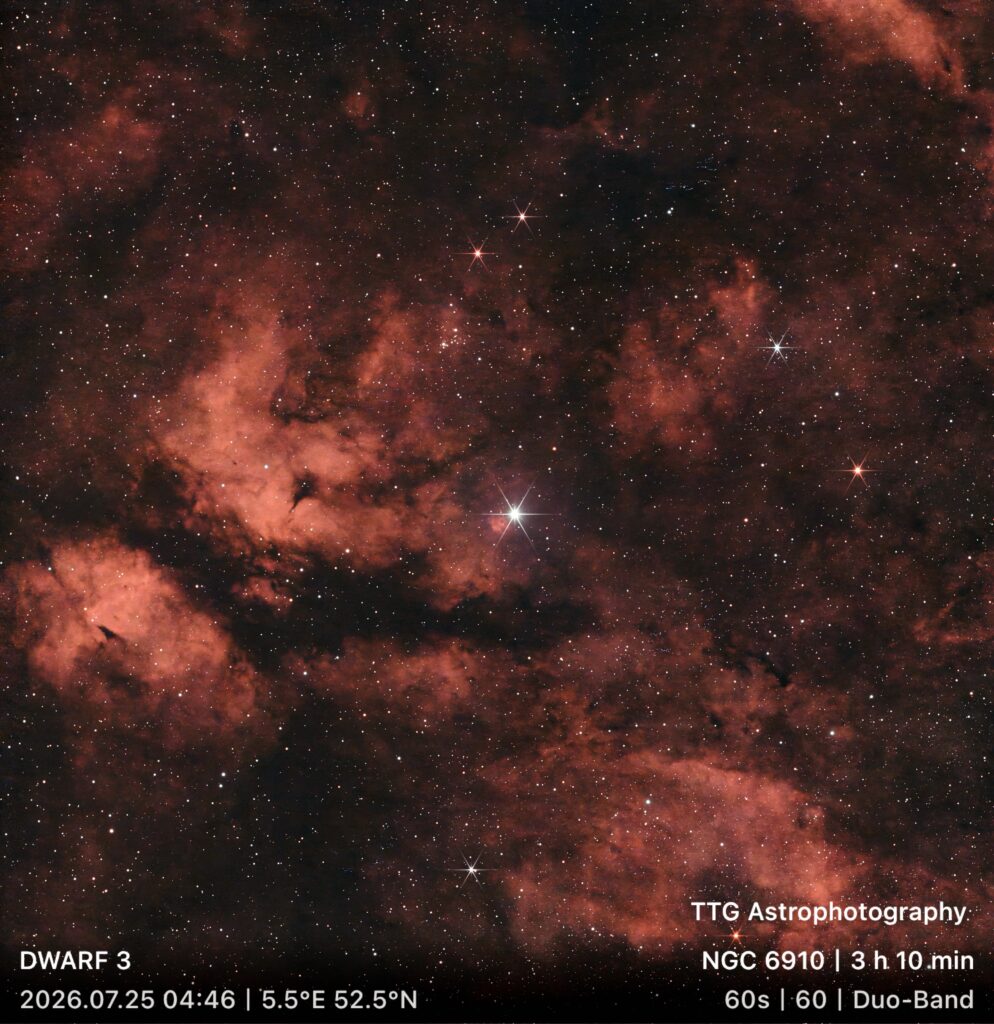

This image showcases one of the most spectacular regions of the northern Milky Way, centered on Sadr (Gamma Cygni). Surrounding this brilliant supergiant star is the vast Butterfly Nebula (IC 1318), an immense emission nebula where glowing hydrogen gas is sculpted by dark dust lanes into wing-like structures. Just north of Sadr lies the young open cluster NGC 6910, whose hot blue stars were born from the very clouds that still surround them. Together, these objects offer a stunning glimpse into an active stellar nursery nearly 4,000 light-years from Earth, where new generations of stars continue to emerge.
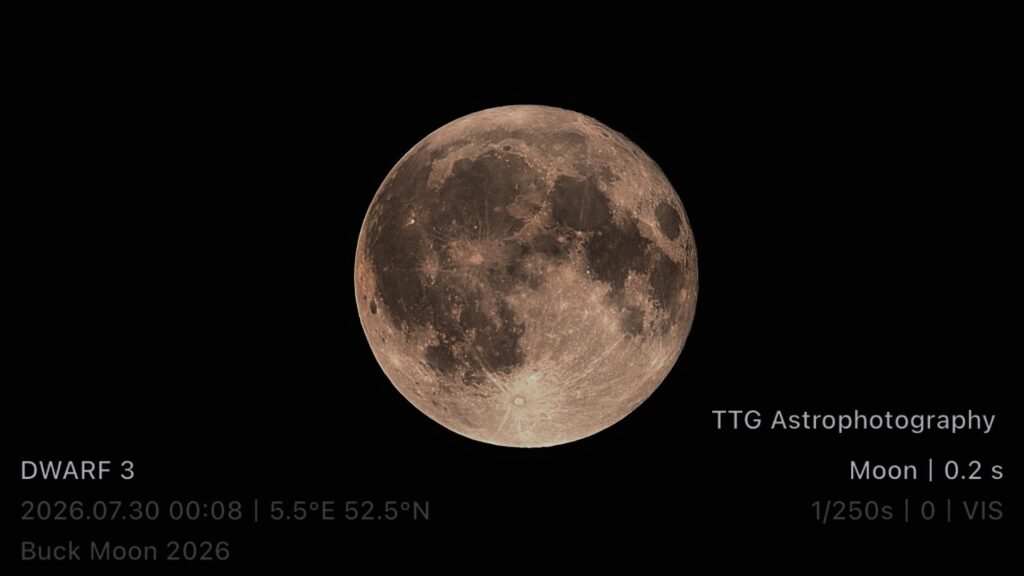
Next this week was the full moon, Buck Moon 2026. Took me some time to frame it correctly as it was low on the horizon, hiding behind the roof tops of the neighbors, but here it is! In the books!
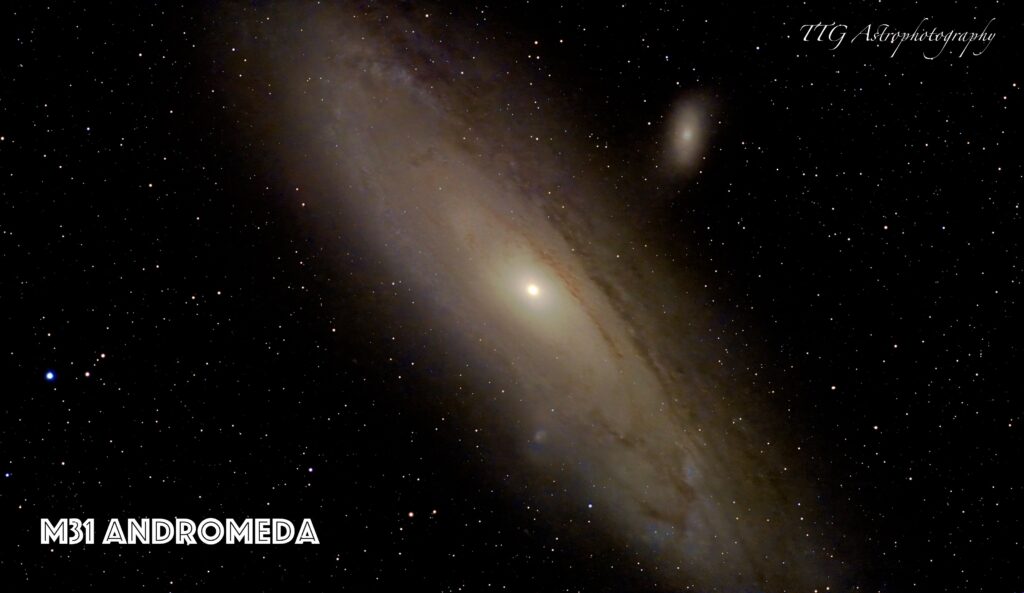
Next, just because I was cleaning up and re-organizing my Dwarf 3 related backup files, I ran the captures I have from M31 Andromeda through MegaStack and Stellar Studio as well. No new captures, just combining old data. Not bad, but as it includes data from a Dwarf 3 unit I had to replace under warranty, it’s not perfect. Probably due to mismatching Dark frames etc. I’ll give our good old M31 some new attention in one of my future sessions, and limit the stacking to the new data. Anyway, still worth sharing IMO.
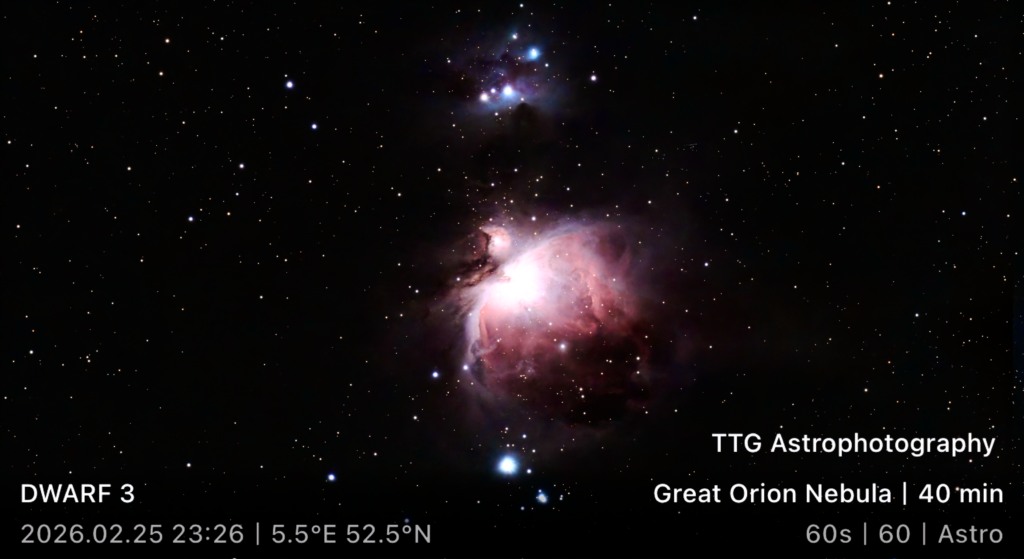
However, the thing I am most excited about for this blog update is the MegaStack combo of Duo-Band and Astro filter. Like I said, something I really have been waiting for, and DwarfLab delivered… and how! What’s even better is that I did not even have to do another session to test it out… I had some data from the Orion Nebula which I captured in February this year, both in Astro as in Duo-Band, and uploaded it back to my Dwarf 3. Only thing I had to do was to select both session in MegaStack and let it combine! After that a bit of Stellar Studio and some tweaking in Apple Photos and this came out of it!
The original capture in Duo-Band:
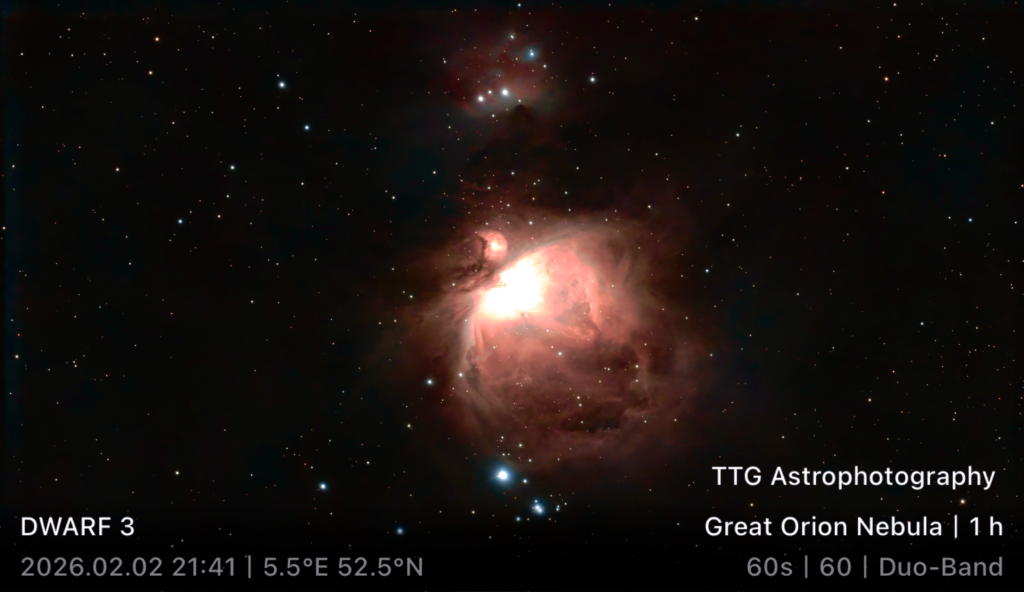
The original capture in Astro:
And then the final result combining both….
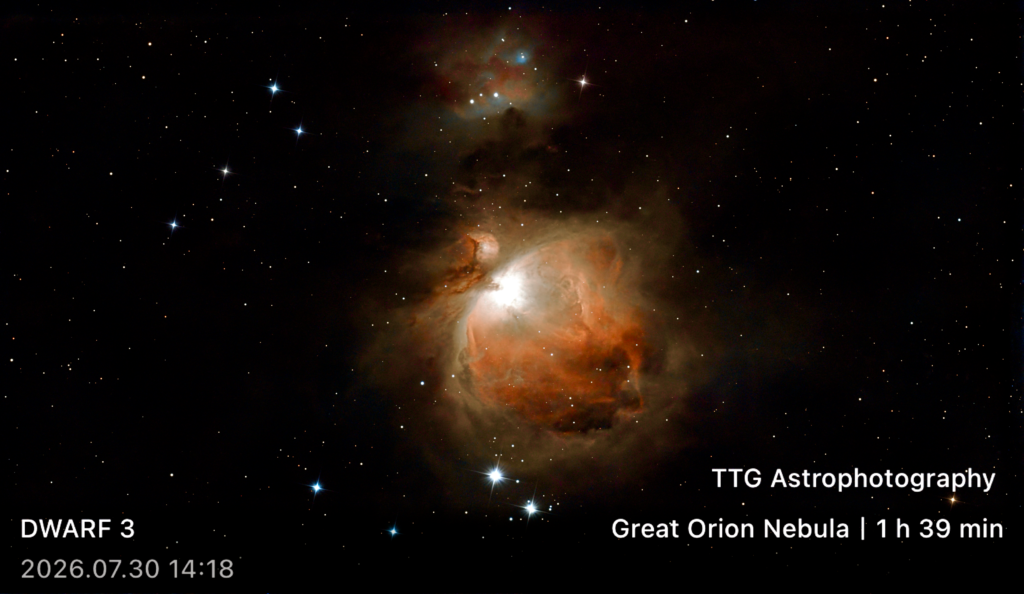
Can you believe this? This result out of a consumer grade Smart Telescope… from my backyard? I don’t know that you all think, maybe I get overexcited with this nerdiness, but if find this amazing! Thank you DwarfLab for this big update!
Next on the agenda is the (for the Netherlands, 89%) partial eclipse on the 12th of August! Looking forward to put the Dwarf 3 out on a Timelapse – weather permitting.
To endless exploration, starry nights, and a little bit of cosmic nerdiness!
TTG


